
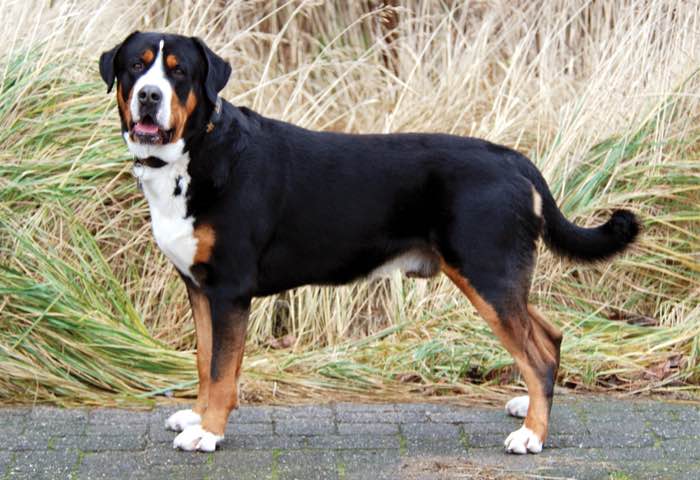
Height
Male: 25 - 29 in
Female: 23 - 27 in
Weight
Male: 100+ - 0 lbs
Female: 100+ - 0 lbs
Colours
Black brown & white, Black rust & white, +1 more
Key Characteristics
General information
Origin
The largest – and perhaps the oldest – of the four Swiss mountain breeds, the ‘Swissy’ descended from mastiffs that accompanied Caesar’s invading legions. Like the Bernese Mountain Dog, this breed was used to assist the farmer and butcher by guarding and driving livestock, to pull heavy carts, and as a watchdog and family companion. In the late 19th century, it was assumed the breed had died out but in 1908, famous dog expert Prof. Albert Heim. of Zurich saw a Greater Swiss and urged breeders to find other specimens and save this ancient Alpine dog. The breed was gradually reclaimed in its native land and spread to other countries. The Greater Swiss was admitted to the American Kennel Club’s Working Group in 1995.
Temperament
Confident, alert, easygoing and obedient with an even disposition, the breed is said to be both bold and faithful.
Activity Level
Alert and vigilant, this powerful breed is of medium energy and eager to work. They generally adapt to their family’s activity level in adulthood, and are happy to do whatever their family is doing. They are not well suited to intense activities such as running long distances, and care must be taken to avoid exercising in high temperatures.
Coat
The short, thick, dense coat is weather-resistant. The breed also wears a thick undercoat. Swissies can handle cold and hot weather with no problems. They love snow and water.
Colour
Grooming
Regular brushing and weekly/ bi-weekly nail trimming is all the grooming needed. Easy to take care off.
Caring for Greater Swiss Mountain Dog
Training, Socialization & Breed Specific Traits
An extremely strong breed that must be well socialized, they can be stubborn and require consistent training to develop good manners and physical self-control. May be vocal when alerting to things out of the ordinary, and have differing levels of prey drive. Puppies may take up to 6-9 months to housetrain due to physical immaturity of their bladder
Health
In general, GSMDs are a large breed with few health concerns when compared to other breeds of the same size. Some health issues to be aware of are Epilepsy, Splenic torsion and enlargement, Gastric Dilation and Volvulus (GDV, or Bloat). Breeding dogs should have OFA tests for Hip and Elbow dysplasia, Shoulder Osteochondritis Dissecans (OCD), and ACVO or CAER Eye Exam.
Clubs
Breed standards outline the ideal characteristics, temperament, and appearance of a breed, and ensure that a dog can carry out its original purpose. They act as a blueprint for the ideal specimen and include size, weight, colour, coat, ear set, tail set, topline, feet, movement, temperament, structure, etc.
Greater Swiss Mountain Dog Breed Standard