
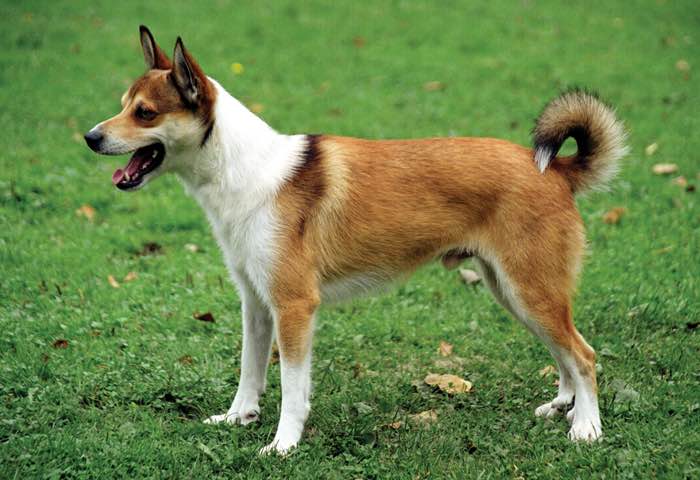
Colours
Black & white, Fallow & white, +5 more
Key Characteristics
General information
Origin
First impressions of the Norwegian Lundehund might lead one to believe it’s a rather ordinary dog of the Spitz family. No way! The Lundehund was bred to climb cliffs on the Arctic islands off the Norwegian coast to search the rocky crevices and caves for puffins, which were popular for eating as well as for their down and feathers. To accomplish this, the breed is virtually a canine contortionist. Incredibly flexible, it can stretch its head back until its skull touches its spine and flex its forelegs out 90 degrees from its body. Most astounding of all, the Lundehund has at least six toes on each foot, some double or triple-jointed, giving the dog unbelievable grasping ability. And when you’re climbing cliffs, that comes in pretty handy. Now, both the puffin and the Lundehund are protected by Norwegian law.
Temperament
Alert, energetic and lively are adjectives used to describe the Norwegian Lundehund.
Activity Level
The Lundehund likes activity but isn’t a hyper canine. A daily walk takes care of exercise requirements, but if you happen to have some cliffs handy, so much the better.
Coat
The coat is dense and rough. Short on the head and front of legs, it is more abundant at the level of the neck, rear of the buttocks and on the tail.
Colour
Grooming
Nothing more than regular brushing is needed.
Clubs
Breed standards outline the ideal characteristics, temperament, and appearance of a breed, and ensure that a dog can carry out its original purpose. They act as a blueprint for the ideal specimen and include size, weight, colour, coat, ear set, tail set, topline, feet, movement, temperament, structure, etc.
Norwegian Lundehund Breed Standard