
Colours
Black & tan, Grizzle, Light wheaten, Red, +3 more
Key Characteristics
General information
Origin
As a working terrier of East Anglia, the Norwich was believed to have been developed by crossing small Irish Terriers with other short-legged terrier breeds. Once known as ‘Cantab Terriers,’ the game and hardy little dogs were useful on the hunt, in the stableyard and as a fun-loving family pet. There was not a lot of uniformity in the breed until 1923 when the breed became known as the Norwich Terrier and a breed standard was accepted by The Kennel Club (England). The name covered both the drop-eared and prick-eared varieties until 1963 when the drop-eared dogs were reclassified as Norfolk Terriers and the prick-eared dogs retained the name of Norwich.
Temperament
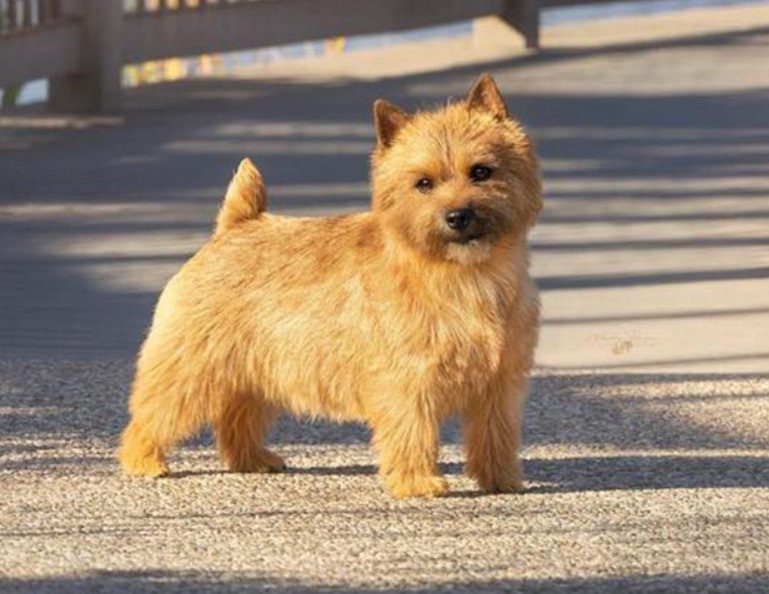
Gay and fearless little teddy bears, the Norwich has a pert personality that endears it to its owners and everyone around them.
Activity Level
Today’s Norwich are mostly family companions but retain the fortitude & desire to hunt. Their small size & jovial temperament make them ideal pet and working companions. They require a fair amount of exercise, playtime in a secure fenced area & walks on leash as the desire to chase small animals is innate in the breed.
Coat
The coat is hard, wiry and straight, lying close to the body. Hair on the head and ears is short and smooth but the coat is longer and rougher on the neck, forming a ruff to frame the face.
Colour
Grooming
Brushing weekly will remove dead hair. Regular brushing will help keep them clean. They do not require frequent bathing. Stripping the coat (pulling out the dead topcoat by hand or with the aid of a stripping tool) maintains the coat’s characteristic hard texture.
Caring for Norwich Terrier
Training, Socialization & Breed Specific Traits
Known for their affectionate nature, Norwich generally loves everyone and does well in households with children & multiple pets. While having a mind of their own, they generally enjoy life & are active & love to play. They also love to eat so care should be taken not to overfeed them as they can gain weight easily. Early socialization is a must.
Health
Upper Airway Syndrome: a complex respiratory condition. Symptoms range from noisy breathing to severe distress. This condition affrects the larynx which controls the amount of air that enters the trachea and lungs. The true prevalence of the condition is unknown.
Epilepsy: affects any breed and little is known of the prevalence in Norwich. Breeders are vigilant in their breeding programs to stay away from any known carriers.
Degenerative Myelopathy: a neurological disorder of the spinal cord causing paralysis. A gene has been identified and breeders have the ability to test for carriers.
Hip Dysplasia: one of the most common skeletal diseases in dogs. Malformation of the hip joint. Breeders have their dogs x-rayed and certified by OFA or PennHip prior to breeding.
Patellar Luxation: a common orthoedic condition in dogs, especially toy/small breeds. This condition may be partially genetic. Breeders have their dogs examined for patellar luxation and certified through OFA.
Primary Lens luxation: an eye disorder that can lead to blindness. Reported to be more common in terriers. A DNA test is available so breeders can determine their status (normal, carrier or affected) prior to breeding.
Clubs
Breed standards outline the ideal characteristics, temperament, and appearance of a breed, and ensure that a dog can carry out its original purpose. They act as a blueprint for the ideal specimen and include size, weight, colour, coat, ear set, tail set, topline, feet, movement, temperament, structure, etc.
Norwich Terrier Breed Standard