At nearly two years old, Miller was everything you would expect from a young Nova Scotia Duck Tolling Retriever. Happy, active and full of enthusiasm. He was happiest running through fields and chasing birds.
"Everyone always jokes that his tail never stops wagging and that we should have named him 'Thumper,'" said his owner, Dallas Hodgins.
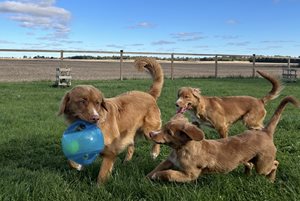 Dallas is the breeder, owner and handler behind RedAero Nova Scotia Duck Tolling Retrievers. A Canadian Kennel Club member for 10 years and Vice President of the Ontario Toller Club, she participates in a variety of CKC events with her dogs, including conformation, field, sprinter and rally.
Miller, born on October 20, 2023, was intended to become Dallas's next hunting and field dog. However, an unusual medical issue would put those plans on hold and lead to months of veterinary visits, tests, surgeries and uncertainty.
In October 2025, Dallas noticed that Miller's hip area had begun to swell. He was periodically lame, and seemingly overnight, the swelling became large and tender.
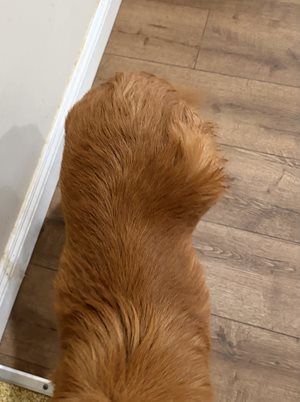 The team at Thames Road Veterinary performed an ultrasound and collected a sample from the area. Because the sample primarily contained red blood cells, the swelling was initially thought to be a hematoma. Miller was prescribed antibiotics, the swelling resolved and he appeared to return to normal.
A few weeks later, Miller underwent hip X-rays and passed his Orthopedic Foundation for Animals evaluation. There were no further signs of the unexplained swelling.
For approximately six months, all seemed well. Then, over Easter weekend in April 2026, the swelling suddenly returned.
Within 48 hours, the area had grown to the size of a softball and Miller had developed a fever from the infection. His veterinarian provided antibiotics and pain and inflammation medication before the clinic closed for the long weekend. The abscess ruptured overnight on Easter Sunday, and Miller was brought in for exploratory surgery the following morning.
Based on how the infection presented and the development of a draining tract, the veterinary team suspected that a foreign object was responsible. However, nothing was found during the surgery. The area was thoroughly flushed, and Miller returned home with antibiotics and instructions for strict crate rest.
Once again, he appeared to heal.
Approximately one month after Miller's first surgery, his incision began to reopen and drain. It was clear that the underlying problem had not been resolved.
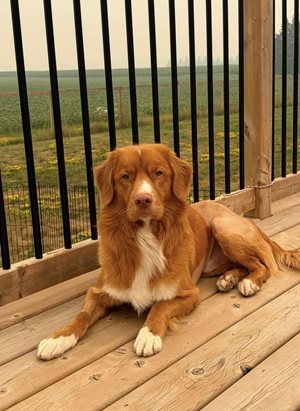 Miller was referred to King Animal Hospital for further investigation. During a consultation in mid-June, a CT scan revealed what appeared to be a foreign object measuring approximately 20 millimetres by 1.5 millimetres. The veterinary team suspected that it was plant material, possibly a thorn or foxtail, that Miller may have ingested before it migrated through his stomach lining and into the muscle near his hip.
A second exploratory surgery was scheduled for June 30. Dallas hoped the object could be found and removed, bringing Miller's ordeal to an end.
Unfortunately, the veterinary team was unable to locate it during the procedure.
"It was heartbreaking to hear that the surgery had been unsuccessful and that Miller would have to go through another," Dallas said.
There was still hope that the object had been flushed out during the procedure, even if it had not been seen. Miller returned home for another course of antibiotics and more crate rest, but approximately three weeks later, the same area began to swell again.
The swelling progressed quickly. Within about 48 hours, another softball-sized abscess had formed.
On July 22, Miller returned to King Animal Hospital for a third exploratory surgery. This time, the suspected foreign object could not be seen on the CT scan or located during surgery. The area was thoroughly flushed once again.
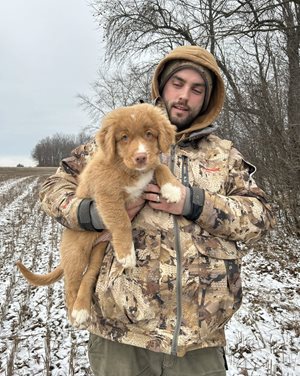 By the time Dallas shared Miller's story with the CKC in early August, he had undergone three exploratory surgeries, two CT scans and a tissue biopsy and culture since April. His care had cost approximately $32,000.
Dallas enrolled Miller with Trupanion in July 2025. She had recently sent home a litter whose new owners received Trupanion coverage and decided to enroll Miller as well because of his future as a hunting and field dog.
Until this experience, Dallas had never needed to use his coverage for a significant veterinary expense.
That changed when Miller required specialized testing and repeated surgeries. His two surgeries at King Animal Hospital each cost approximately $10,000 to $12,000, while each CT scan cost between $2,000 and $3,000.
Of Miller’s approximately $32,000 in veterinary costs, Dallas said Trupanion covered approximately $26,000.
“Having coverage did affect our decision process,” she said. “We simply would not have been able to pay more than $30,000 out of pocket for this issue. Surgery was the only potentially curative option, and I’m glad we were able to go that route.”
King Animal Hospital requires payment based on the high end of its estimate before surgery. Dallas said Trupanion was able to confirm her coverage amount within minutes by email, allowing Miller’s treatment to proceed. Through direct payment, Trupanion could also pay the hospital rather than requiring Dallas to cover the entire cost and wait for reimbursement.
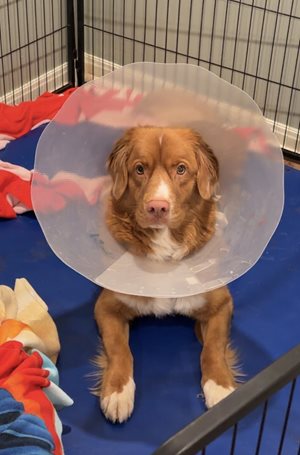 “The whole process has been effortless on my end, and I am just so thankful to have had him insured,” she said.
For Dallas, that support meant more than help with the veterinary bills. It allowed her to focus on Miller’s needs during an already frightening and uncertain experience.
“Trupanion lifted a huge weight off my shoulders,” she said. “It made the process so much easier, and I felt as though we could make better decisions to get better results because of it. Without Trupanion, we may not have Miller right now.”
As a breeder, Dallas has always sent her puppies home with a month of Trupanion coverage. Miller’s experience has reinforced how strongly she will encourage puppy buyers to maintain that coverage throughout their dogs’ lives.
“There’s nothing worse than having to make some of the hardest decisions about your dog because of financial hurdles,” she said.
She also believes Miller’s experience illustrates why relying solely on personal savings may not be enough when an unexpected medical emergency occurs.
“Miller’s situation was a complete fluke that likely happened while he was running through the fields,” she said. “When bad things happen, I’d rather be able to make the best decisions for my dog without feeling completely limited by finances.”
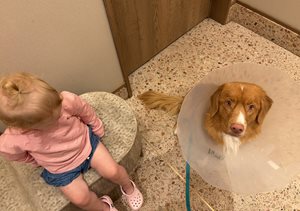 At the time Dallas shared her story, Miller was two weeks out from his third surgery. His incision was healing well, there had been no further swelling and he had finished his antibiotics. Although he remained on crate rest, his spirits were high.
The suspected foreign object was never definitively located, and Miller’s recovery continued to be monitored. Still, Dallas was hopeful that the latest procedure had finally resolved the issue.
“Miller is a very young, active dog who is full of potential once this is cured for good,” she said. “This horrible fluke has been so difficult to navigate, but Trupanion has made everything so much more bearable.”
Through three surgeries and months of uncertainty, Miller’s resilience and endlessly wagging tail have remained. Dallas hopes that once his recovery is complete, he will be able to return to the fields and the active life he loves.